
When a baby emerges from the womb, the baby’s brain already has all the learning essential for the correct functioning of the body. The neural circuits for breathing, heartbeat, kicking, sleeping, blood circulation, etc., are all ready! The baby can track a moving object, orient towards Mom or Dad’s face, feed, or even has the desire to walk when you hold it up with feet touching a flat surface. Isn’t that interesting when our whole premise is learning based on “DATA”?
Let’s start from the beginning.
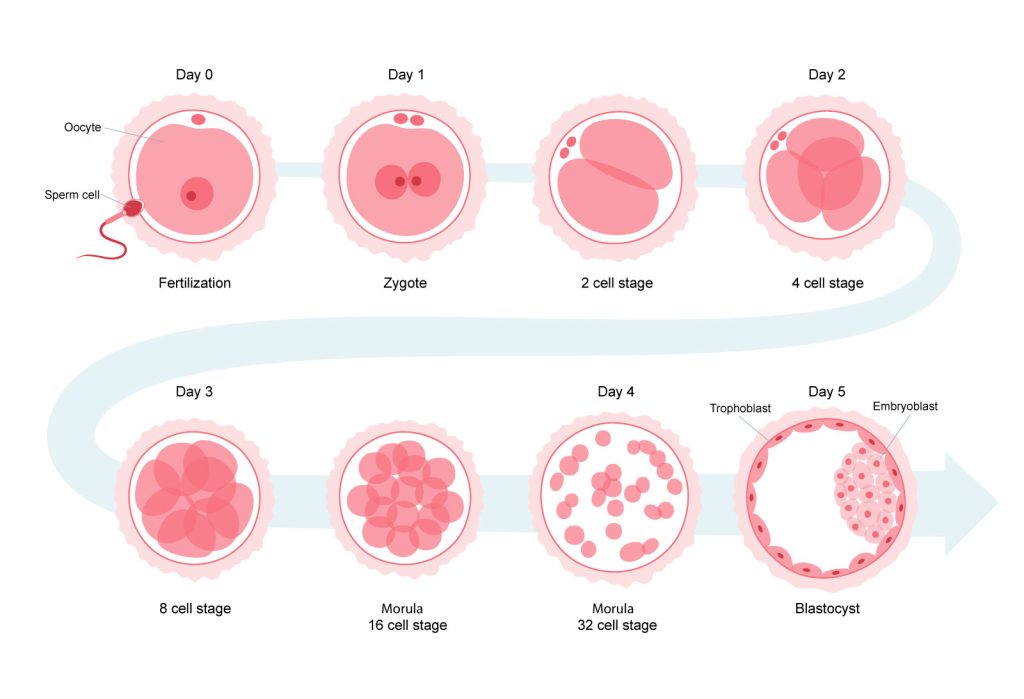
We start from a zygote, a cell formed by the fusion of the male and female gamete (gametes are the male and female with only 23 chromosomes, unlike the regular cells with 46 chromosomes). After the fusion, the zygote has a complete set of 46 chromosomes. In case you forgot, genes are segments of DNA, and chromosomes are the cells’ structures that contain the genes – hundreds to thousands of genes. So zygote contains the DNA – the complete DNA that defines us. DNA is a fascinating multidimensional code ever known to humankind. It is not your typical software function. It has the encoded instruction set for complete development.
From one cell, the zygote will soon become multicellular, as each cell will undergo mitosis. The cells divide, and the new cells have identical copies of the DNA as the original cells. The cells rearrange themselves spatially to form three layers that differentiate into different organ systems. The cells multiply and change. They produce cells that become white blood cells, red blood cells, nerve cells, eyes, liver, fingers, toes, hair, heart, skin, etc. A cell becomes a palm, an adjacent cell becomes a finger, and another becomes a nail. Not only does a cell know what to do, but it also knows what neighboring cells should do. The DNA instruction set is controlling this.
But to me, the most fascinating thing is the learning that gets developed in the brain. The cells give rise to all the neurons in the brain stem so that a newborn knows what to do – kicking, grasping, crying, sleeping, rooting, feeding, etc. The correct synaptic connections, the correct synaptic weights, the correct inhibitors, the correct circuits! Nothing is random – a well planned execution of the DNA code.
The code in DNA builds these initial learning/inference models in the brain.
Initial learning is coming from DNA … transfer learning. But the kicking, grasping, crying, sleeping, rooting, feeding are not the only elements of learning that a newborn is born with. There is lot more learning in the brain – the unconscious bias – the things that we will discover about the baby as the baby grows.
Let me ask you this. What is something that you know today but you have never learned?
When we use the term DNA, it may sound that learning is influenced only by the parental genomes, but it is a lot more interesting. Along with the genome, we also have an epigenome.

The epigenome is a series of chemical tags (called epigenetics markers) that promote or repress the expression of genes without altering the genome. These epigenetic modifications are added in response to the physiological or environmental stimuli our cells receive. Diet, stress, habits, learning, exercise are a few examples that can permanently alter the epigenetic profile of an individual. Researchers use the term “imprinted genes” to refer to genes influenced by the epigenetic markers. The DNA is not modified, but these epigenetic modifications influence the instruction code contained in the DNA.
Epigenome is the software layer on top of the DNA code.
The learning in the newborn is not just coming from the DNA i.e. defined by the parental genome – the default learning of a baby is influenced by the epigenetic modifications too. These markers fully influence the zygote development. Our learnings, Karma, habits, environment, and lifestyle influence what our newborns will know by default. A child may have the same habits as the father. A child may know things the mother spent years learning. All these sentences make sense biologically. The genome and epigenome take part in that initial learning. It is not just the kicking, grasping, crying, sleeping, rooting, and feeding; unconscious bias, aptitude, habits, and a lot of learning is transferred from generation to generation.
Are people responsible for the (unconscious) actions based on the learning/behaviors they are born with? That is a debate we can discuss another time.
Now, let me ask you this. What are the epigenetics-specific learnings that you think came from your parents?
Regardless, this is very interesting for AI/ML engineers as brain development from the genome and epigenome offers a cue to storing model, transfer learning and incremental model change mechanisms. Brain is fascinating and to build real intelligence, we need to dig a lot deeper – not just neurons but also genome and epigenetics. Answers are in the nature, we just need to look closer.